

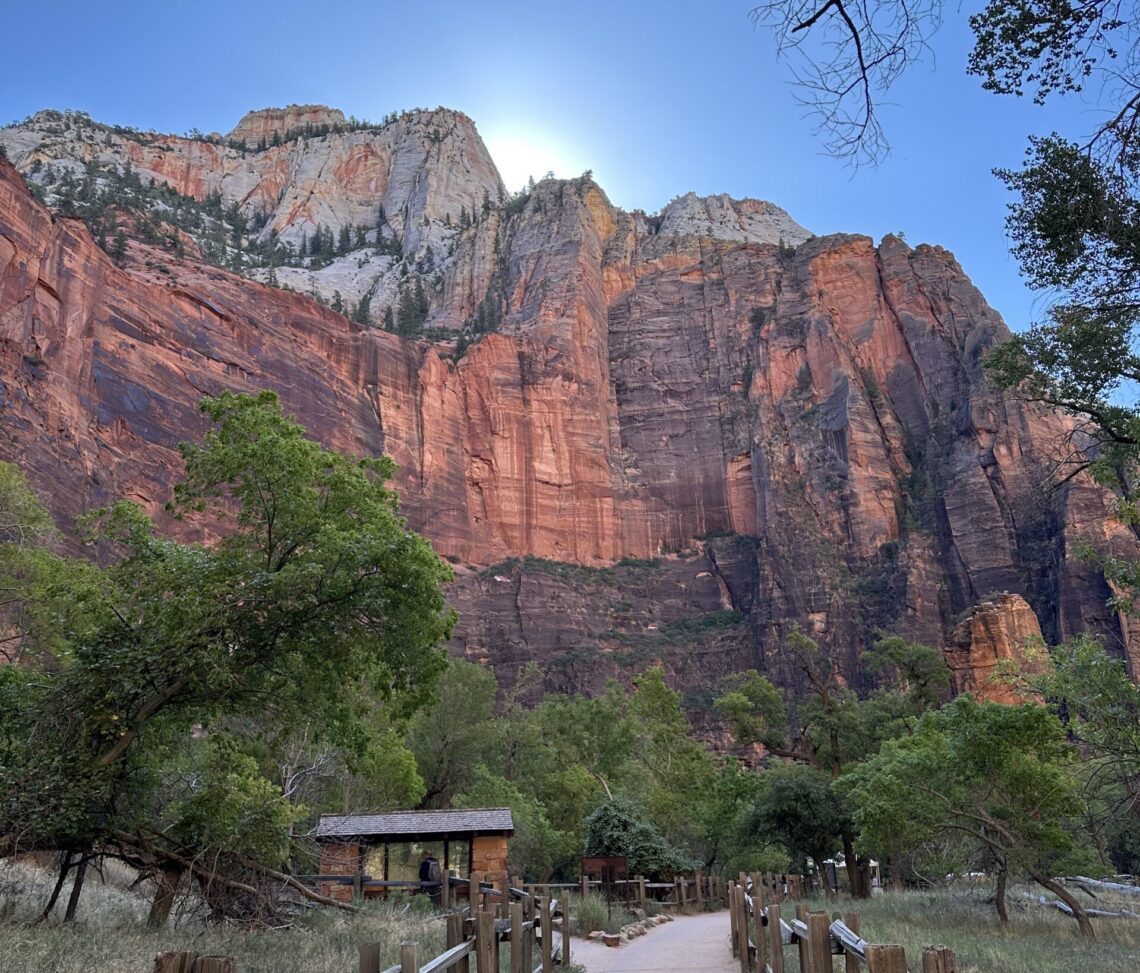
A Quick Visit to Zion National Park in the Summertime
Zion National Park is a popular park that requires some planning ahead, at least a day in advance, of your visit. You can arrive at the park mid-day, but you need to be prepared for it to be very busy with potential long lines for the shuttle buses, crowded shuttle buses, busy trails, and full parking lots.
When driving into Zion National Park from the South, you will be entering on Highway 9, which takes you through Springdale, Utah and into the South Entrance of Zion National Park. The main scenic road that travels to the main sites of Zion National Park is called Zion Canyon Scenic Drive. This scenic drive is closed to regular traffic and is used only by shuttle buses and bicycle riders. At the point where the ‘shuttle buses only’ portion of the scenic road starts, the road branches to the right for regular traffic to continue out of the park along the scenic Zion-Mount Carmel Highway.
How early should I arrive in Zion National Park?
If you would like to find a parking spot within Zion National Park, that is included in the national park admission price and is close to the Visitor’s Center and the Shuttle Bus pick up point, you will need to arrive at least before 8am.
If you are traveling to Zion National Park from a far distance, it works best to drive the day before your planned visit, stay overnight within a reasonable driving distance to the park entrance, and then you can arrive first thing in the morning.
What are my options if I cannot find a parking spot within Zion National Park?
If it does not work with your travel schedule to stay overnight and begin your day early in the morning or if you find that the parking lot within Zion National Park is already full when you arrive, you can pay to park for the day in the town of Springdale. The parking rate per day in Springdale ranges from $15-$25. From Springdale you can take shuttle buses back and forth into Zion National Park, where you can then get onto the official National Park shuttle bus.
Can I ride a bicycle on the scenic route through Zion National Park?
If you would like to avoid riding and waiting for shuttles buses, you can choose to ride your own bicycle or rent electric bikes, for around $79 per person, per day, from Springdale. From the Zion National Park Visitor’s Center, the scenic road is 8.5 miles one way to the Temple of Sinawava. When riding your bike on this scenic route you are expected to pull off to the side of the road and give the right of way to the shuttle buses.
Zion-Mount Carmel Highway Tunnel Restrictions:
Oversized vehicles over 7 feet 10 inches wide and over 11 feet 4 inches tall need a $15 permit that is good to two trips to drive through the tunnel on Zion-Mount Carmel Highway.
Bicycles, pedestrians, single vehicles over the length of 40 feet long, combined trailer and vehicle length over 50 feet long, and any vehicles over 13 feet 1 inch tall, are not allowed to travel through the tunnels on the Zion-Mount Carmel Highway.
What if I need to park an oversized vehicle?
If you have a hitch carrying or towing something that extends the length of your standard vehicle, you are considered to be an oversized vehicle for Zion parking lots. There is a specific oversized vehicle parking lot within Zion National Park, first lot to the left on the road when heading to the Visitor Center. It is best to arrive early to acquire one of these parking spots. The specific time that the lot fills up can vary, but most likely by arriving first thing in the morning, as mentioned above, you should be able to find an open oversized spot. If you cannot get a spot, there is paid oversized parking available per day in Springdale for $30, $15 after 1pm, in Zone C only.
Once you are in Zion National Park, you can board the park’s shuttle buses, ride along, stop at your preferred hiking stop, hike, and then go back to a shuttle from the left or right side of the road in the direction you would plan to head next. Be mindful of the start and stop times of the shuttles. The last shuttle is the last shuttle and they will leave you behind if you are not on it. The shuttles run regularly and there isn’t a very long wait between shuttles. As the park gets busier in the day it is crowded on there and you also could be standing. The buses do have air conditioning that you can request for the driver to turn on if it is not already on.
Where should I hike? Which shuttle stops should I get off at?
You can start in the Visitor’s Center, pick up a park map, and ask about hikes that are a highlight of the park. You should also check for any flash flood warnings in the area that can impact whether a trail can be safely accessed or not. During our visit, we first rode the shuttle all the way up to the last stop, the Temple of Sinawava, walked the Riverside Trail and some of the Narrows trail, rode the shuttle to Weeping Rock, walked the short path to see the Weeping Rock, stopped at the Zion Lodge shuttle stop to hike the Lower Emerald Pool trail and rode back to the Visitor’s Center to our car. This took around 4 hours to see and we left the park in the afternoon as the temperatures were getting hot. It worked really well to arrive at the beginning of the day to enjoy the sun rising above the canyon walls, the cool morning temperature, and to be able to sit down and look out the windows on the shuttle buses along the drive because they were not very crowded yet.
What is the Narrows Trail like?
The Narrows trail is a very popular trail for visitors. From the Temple of Sinawava to Big Springs and back is 9.4 miles round trip to hike. I recommend for everyone to at least walk the 2 mile round trip Riverside Walk up to the Narrows. This will bring you to the point where in order to continue you would need to wade through water. During our visit, we decided to wade through about three sections of water that covered our feet and lower legs. If you continue further than the shallow water you would be wading through above waist water.
Whether you choose to continue beyond the Riverside Trail and wade in the water or not, you will still see be able to see the beautiful scenery of the Narrows along this trail. I had trouble finding much information prior to our visit about whether you need to hike the Narrows to see the scenery, but you can walk as far as you would like and still see a lot. If you plan to walk through water, be prepared with the appropriate footwear and, depending on how deep the water is, you will want to consider also having hiking poles for stability. Do not hike if there are Flash Flood Warnings while you are visiting! Flash flooding is very serious, happens very fast, and should be taken seriously. Always check with the National Park rangers before hiking.
Are there other popular hikes in Zion?
Angels Landing is one of the most popular hikes at Zion National Park, but you need to apply to be a part of the lottery for a hiking permit before 3pm MT the day before your visit. The application fee is $6, is non refundable, and includes up to six people on the permit. There is an additional fee to hike if you are selected in the lottery at $3 per person. You find out if you got selected after 4pm MT the day before your visit. Because I didn’t know the end time for the application, I was too late checking on the specifics the day before, and we didn’t do the Angels Landing hike during this visit.
Zion is a beautiful park. Because of how the park is designed, you are able to be within the canyon and enjoying its unique and extraordinary scenery with little effort beyond taking a shuttle bus ride. There is also trickling water and plenty of greenery to see amongst the inner canyon, which is much different from the scenery of nearby Utah National Parks; Bryce, Arches, and Canyonlands.


You May Also Like

3 Comments
plataformazww
Trying out plataformazww and so far, so good! The selection of games is impressive, and the site is fast. Give it a shot, you might just like it! plataformazww
78gamelogin
Just logged in to 78gamelogin and the setup is pretty straightforward. Games load quickly and haven’t had any issues yet. Decent experience so far. 78gamelogin
167betapp
Grabbed the 167betapp and it’s pretty clean. Simple to use, and I haven’t had any problems with withdrawals. Pretty happy with it so far! 167betapp